Yesterday was Johnny’s funeral. He passed away on 22 October, aged 72.
Johnny worked with my parents from 1974 until a few years ago, when he could no longer keep up the physical work around the garden and in the house. His son, Bradley, took over to continue the work Johnny started almost 50 years ago.
Johnny was very much part of the Schutte family, just like Queenie, who was our domestic worker for many years.
When Queenie died in 2009, I was in South Africa and able to go to her funeral. My mother couldn’t make it, but sent a eulogy for me to read on the day. This time, I couldn’t be there for Johnny’s funeral, but my mother read a eulogy on my behalf.
Below is that eulogy, translated from the original Afrikaans.
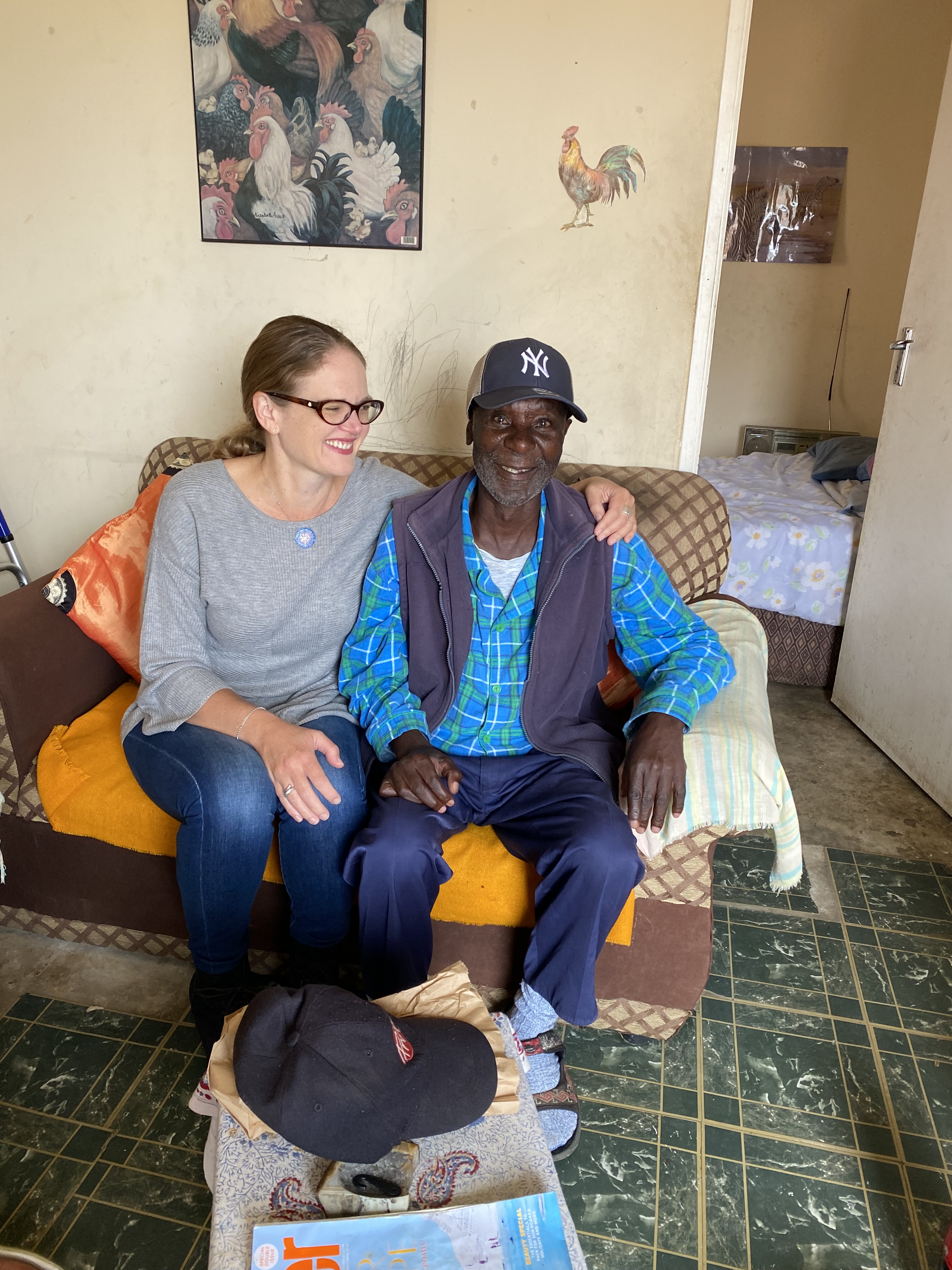
At Johnny’s old house, 2009
Johnny was part of the Schutte family before I was. So for me, he was just always there.
I didn’t know him very well when I was younger. Not like my brothers, who used to sit with him and eat and chat when they were little.
But when, in later, years, I wrote a book about Knysna and my family, it gave me an opportunity to get to know him better. Because it wouldn’t have been a story about my family if Johnny wasn’t part of it.
He was a man of few words, but he told me his story like only he could.
I’ll never forget, there was a day when I went to visit him so he could show me his house – the old house, not the RDP one that he waited for for so long.
The house was down a slope, and I wasn’t wearing the most practical shoes.
At the end of the visit, I had to climb that slope in my stupid heels. And suddenly I became aware of a light pressure on my lower back. It was Johnny’s hand, just in case I needed him.
That moment, for me, sums up the role Johnny played in my life. I didn’t necessarily always see him, or hear him. But he was always there.
And now, he isn’t there anymore.
We’ll miss you, Johnny Oliphant. Rest in peace, my friend.
Johnny signs his chapter at my book launch in 2019The last time I saw Johnny, October 2022
He had been sick for a while, and I was able to get to South Africa just in time to say goodbye. He wasn’t entirely conscious the night we got there, having had a minor stroke and a heart attack since being admitted to hospital two weeks before. But when I got to his side, he raised his hand as if he was reaching for mine. I held it for the longest time, and I hope he knew I was there.
He died the next day, with mom, me, and my partner Joe by his side.
In the days and weeks that followed, we realised just how much he had meant to so many people as an overwhelming number of tributes rolled in. Thank you to everyone who got in touch with messages, cards, flowers, food, and hugs.
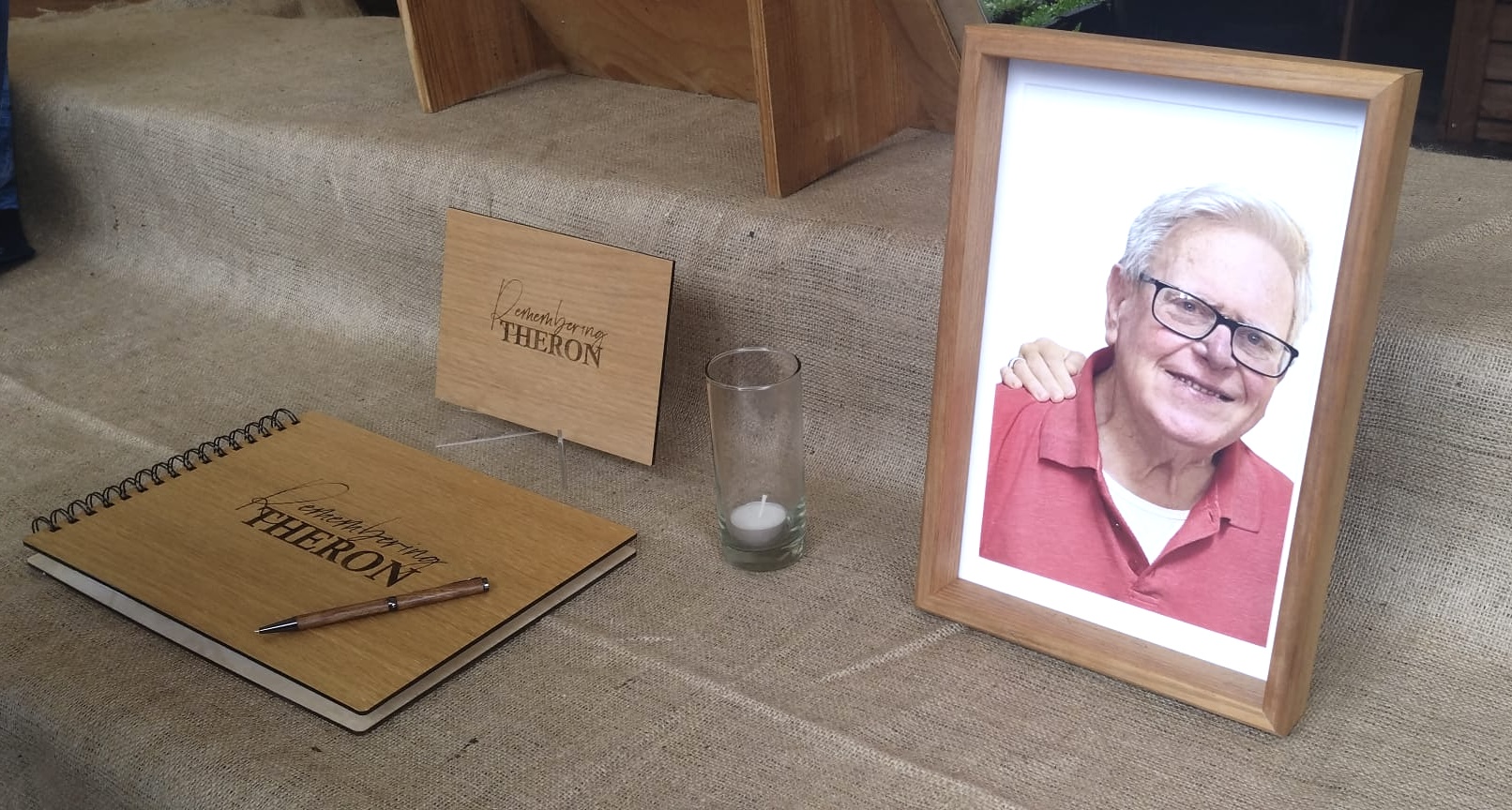
The celebration of his life was held at the Harkerville Market, where mom and dad had a stall for the past 20 years. It had become his happy place in his retirement, making it the perfect place for his final send-off.
Somehow, my incredible mom found the strength to write and deliver a eulogy on the day. As she said herself, no one knew him like she did – and she wanted everyone to know just how amazing he was.
Here is that eulogy, in full.
“Theron was the second eldest of five brothers, born to a music teacher mother and a lawyer father. When I think of him, the following words come to mind: creative, sensitive, perfectionist (if it wasn’t 100% it’s not good enough) kind (telling me that I cannot give up on a certain person because she has nobody else), loyal, caring, excellent cook, highly intelligent, but also strong willed and very stubborn.
He loved fishing from a young age, when the family moved from Pretoria to the Strand. Many a tale was told but my favourite one was when he and his father went fishing on a tractor tube until a fish with a sharp fin pierced a hole in the tube. Theron had his finger in the hole while his dad rowed like crazy on the other side, causing the tube to go round and round. Eventually they reached the shore safely! They built their own boat later to start fishing more seriously.
Theron and a friend also started diving, making their own diving gear including their wetsuits.
He played many sports – mainly rugby and athletics, where he got Western Province colours for discuss and shotput. Later he also played hockey and squash.
He was very musical and had a beautiful baritone voice. He took singing lessons in Stellenbosch, where the professor told him it’s either a singing career or teaching. He chose teaching, but still sang leading roles in school and varsity operettas and later, many productions of the Knysna Music Society. He and Helena Bruwer often teamed up to sing the most beautiful duets.
His first teaching job was at the Zwaanswyk High School in Cape Town, where he trained the school choir and cadet band.
He always had an enquiring mind and a wide general knowledge. He just knew something about everything. In the many tributes we’ve received from ex-students, this one stands out: “Before Google, there was Mr. Schutte.”
We got married in 1969, and in 1971 we moved to Knysna where he became the Biology teacher at the Knysna High School. He touched many students’ lives as we’ve been reminded these past two weeks. On Facebook alone, there have been almost 200 messages from students he taught.
Theron believed in hands-on learning and many experiments were performed in his class to make life more interesting – from dissecting pigeons to inflating sheep’s lungs and making them bleat.
He was a sports coach and driver, taking athletes and teams to many games and events. He maintained the sports fields and before each event you would find him with his little cart, chalking the fields.
For the school plays, he was the stage manager, did the lighting and special effects, and built the sets.
We never had new cars, but we never needed them because Theron would fix and maintain whatever secondhand car we bought. That’s actually how we met. When I started work in the Strand, he fixed a Morris Minor for the welfare organization where I was a 21-year-old social worker.
My children firmly believed he could fix anything! And he could also make anything, it seemed.
He became involved in projects in the townships and when the teachers in the White Location needed accommodation, he spent his afternoons and weekends building them a house with the help of a neighbour and Johnny, our gardener at the time.
Every year at the Winter Festival, Epilepsy South Africa had a pancake stall at Loerie Park as a fundraising event. Theron not only built the work surfaces for the stall, but also helped to set up the stall every year. He had the gas bottles filled the night before, and then he’d be in his workshop cutting reams of greaseproof paper into 4,000 pancake-sized pieces.
When anyone needed help, he was there. But he was always there for his family first.
When I went back to work, he would fetch and take the children to their various after-school activities. When Anelia’s car got stolen in Durban, he had a new second-hand car for her within two days. He drove it to Durban and got the bus back to Knysna – a 17-hour journey.
We built our own house with the help of one bricklayer and an apprentice over three years – when I became pregnant, I was relieved when people started asking when the baby is due, instead of when the house will be finished! And this is the same house where we stayed for the last 52 years.
Woodwork was always his hobby, and when he took an early retirement package in 1996, it became his job. We joined the Harkervillle Market, right here, in 2003 where we had a stall for the last 20 years. He made amazing wooden toys and it was so rewarding to hear from people who are now adults how much the toys meant to them when they were young. Especially the penguins and toy guns.
The market played a big role in our lives and was the main reason he bounced back after every serious illness. The stallholders became our special friends and extended family and we were so grateful to have that.
His health started to deteriorate over the years, but by the grace of God he survived colon cancer, a heart valve replacement, a stroke, a spider bite, being run over on his motorbike by a bakkie, and long Covid that lasted five months. Along the way, two toes were amputated, along with half of his little finger after he literally cut it in half lengthways. He was quite proud that the cut was perfectly symmetrical. What an achievement.
He also had a knee replacement six years ago and in the end, it was an infection in this knee that finally led to his passing.
We were blessed with three exceptional children and their spouses and two beautiful grandchildren. Thank you to Francois and Sinead, Rudolph and Lisa, and Anelia and Joe for all the help and support. Without you, I never would have been able to make it and our lives would have been very bleak.
What a privilege it was to be married to this very special man for 55 years and 5 months.
Rest gently, my best friend and love of my life. I will miss you forever.”
Hard to believe it’s been five years since For the People was released as an e-book. Back then, I was interviewed by Eon Engelbrecht on Knysna FM as part of my mini-publicity tour. As I gear up for the launch of the paperback this week and next, here’s that blast-from-the-past interview on Soundcloud.
I will be in the Knysna area from 14 – 22 June, doing various signings and interviews in Knysna, Plett and George. Do stop by to say hello and get your signed copy of For the People.
I am over the moon to announce that For the People will be published by Harper Collins on their HQ imprint, and distributed in South Africa by Jonathan Ball, publishers of books by Malala Yousafzai, Sir Percy Fitzpatrick and Stephen Hawking, in June 2019. Huge thanks to the team at Harper Collins UK for making it happen.
I’ll be heading over to South Africa for the launch – more details to come, so watch this space.
I first found out about it here in New York when I woke up to Facebook posts, pictures and videos from friends mentioning fires around our home town.
One friend had posted a report from the local municipality that detailed multiple fires, but they were in areas I’m not all that familiar with, or don’t know at all. Hooggekraal. Springveld. De Hoop. Fires high up in the mountains and in plantations. Fires far from home.
But further up my Facebook feed, friends in Knysna were starting to panic. Back roads were being closed. Houses on the outskirts of town were being evacuated.
At 9am EST I spoke to my mother, who confirmed the fires were spreading but reassured me their neighbourhood of upper Old Place was out of harm’s way.
“There aren’t that many trees around here,” she said. “We’ll be fine.”
“Why don’t you at least pack a suitcase so you’re ready in case something happens?” I said. “With things like your passports and IDs.”
“Ag, there’s no need for that,” she said.
She sent me a few pictures she’d taken of the smoke-filled sky, some from the middle of town, some from the balcony of our family home, overlooking the lagoon. Curious-onlooker pictures.
It looked bad, but still distant.
But the panic on my Facebook feed spread as fast as the fire. Posts became more frantic as the local authorities closed the N2 on both sides of town, isolating the residents within. Videos showed lines of cars trying to get out against a backdrop of flames and smoke. Friends who, like me, are thousands of miles from home in places like London and Washington and California started begging for information about families they couldn’t get hold of.
I called my mother again. This time, she said my father had connected the hose pipe, “just in case.” The fire wasn’t near them yet, but gale-force winds meant it was out of control and helicopters were unable to take off to help.
At 2.35pm EST, I got the news that my parents, too, had been evacuated. On their way out, I found out later, they had grabbed my father’s medication, a few sets of underwear and Tess, the cat. Remembering my advice, my mother grabbed their passports too.
For the longest hour, I couldn’t get hold of my mother after her cell phone battery died. The last message I got through to her was “Keep dad’s phone on!” The last message I got back was “We left it behind.”
I had never felt more helpless, or further away from home.
In the end, my parents were lucky. Their home survived, despite two houses burning to the ground just a street or two away.
But so many others were less fortunate.
Hundreds of people in and around Knysna have lost their homes, their businesses, their farms. Five people lost their lives.
That number will no doubt go up, as the losses in Knysna’s townships haven’t been accounted for yet. My mother says at least 80 homes burnt down in one township, some of them shacks, some of them brand new RDP houses built as part of the government’s Reconstruction and Development Programme.
My heart breaks for everyone in Knysna who’s lost everything, and for everyone in the towns further along the coast as the fire continues to spread.
But in the aftermath of this horrific disaster, love, kindness and generosity are spreading too. From all over South Africa, people are coming to Knysna to bring food, clothes, supplies and support. Locals are opening their homes to strangers. Volunteers are going round rescuing pets that got separated from their owners.
“How did if affect you, having your mother do that work in the townships back then?”
The question came from a social worker at my book launch in Knysna last year.
I laughed it off. “It didn’t affect me at all,” I said. “Except maybe that my mom often worked late, and there were many afternoons that I waited for her outside the library after it had closed. So now I’m paranoid about being late for anything, because I know what it’s like to be the one waiting.”
Recently, the same question came up again. I was out with an old friend: an ex-investigative journalist who’d discovered therapy – a dangerous combination when you”re on the receiving end of his probing questions.
I gave him a similar answer to the one I’d given that social worker, adding that even if my mother hadn’t been around much when I was little, my dad always was.
My friend didn’t buy it.
“There’s no way you weren’t affected,” he said.
I ignored him, and the conversation moved on to work; life in New York; the usual. And then somehow we landed on the topic of me and my ex-husband, and the marriage that was no more.
I told him about an incident years before, when my husband didn’t come home from a night out with friends. He’d texted me at midnight to say he was on his way, but when I woke up at 4am, he still wasn’t there. His phone went straight to voicemail and I didn’t hear from him for another five hours.
He was fine, of course (the clue being in ‘ex-husband’, not ‘late husband’). He’d had a few more drinks after the midnight text, and spent the night at a friend’s house rather than drunkenly manoeuvring his way home on a night bus.
But for those five hours between 4am and 9am, I was convinced that he was dead, imagining him being mugged and stabbed and bleeding to death on a dark street somewhere in South London.
By the time I got to work, my brain had processed the information, got over it, and gone to a strange, calm place where I was considering when to phone his parents, what to say to them when I did; even how to get into to his bank account to pay his half of our rent.
By the time he finally called, I was googling “stabbing South London” to verify my conviction.
“The thing is,” I said to my friend, “It wouldn’t have been such a big deal if he hadn’t texted me to say he was on his way.” I could feel myself getting worked up. “Because he knew that’s a thing in my family.”
My friend looked triumphant as memories long forgotten came back to me all at once, falling into place like Tetris blocks. I’m five years old, sitting on my haunches in the corridor above our dining room, peering through the wooden slats at my dad below. He’s on the phone, calling the police, the hospital and eventually the morgue. All because my mother wasn’t back from the townships at the time she’d said she’d be.
When I saw my brothers last Christmas, I told them this story.
Being older than me, their memories were even more vivid. “Do you remember you and me, standing in the kitchen crying?” asked Rudolph. I genuinely didn’t.
“Ons het gedink Ma was dood,” he said. We thought Mom was dead. And the whole time, our father was on the phone, making those calls. Call after call after call.
Suddenly it all made sense; not just my reaction that night in London when my husband didn’t come home, but also the incredibly tangible fear that had set in from the moment we’d got married: that he would die. Because in my mind, modelled on my parents’ example, that was what marriage was: the constant fear of one of you dying; a fear that, at a time when my mother was going into a conflict zone during riots and unrest, was all too real.
Having realised this, I don’t exactly know what to do with the information.
But if I ever overreact when you don’t turn up after you’d said you were on your way, I hope you understand.





 Anelia Schutte